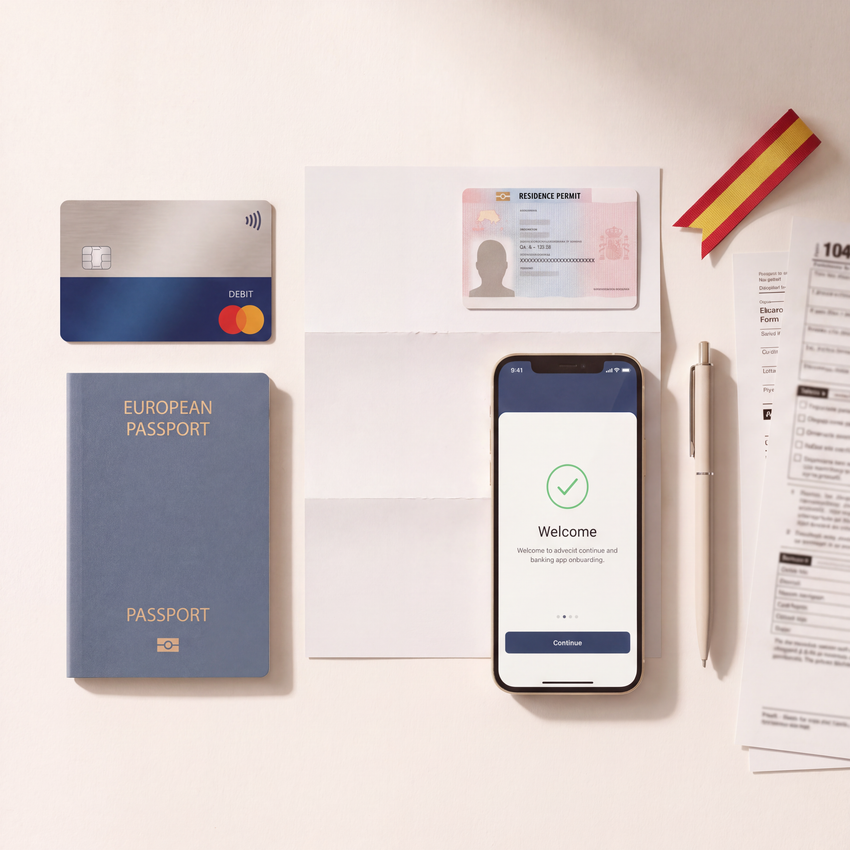
A non-resident bank account in Spain is an account for people who own property, earn income or spend time in Spain without being legal or tax residents there. To open one, most banks ask for your passport or ID, a Spanish NIE, proof of your address abroad and an explanation of why you need the account. Fees are often higher than for residents, and some banks require a minimum balance or a visit to a branch. Conditions vary a lot between banks, so compare at least two or three before you apply.
Disclosure: [Add affiliate disclosure here if this page contains affiliate links.] Requirements, fees and policies change and differ between banks and branches. Always confirm current conditions with the bank before you apply. This guide is general information, not financial, tax or legal advice.
Table of contents
- What is a non-resident bank account?
- Who needs one (and who does not)
- Requirements and documents
- What a non-resident account is used for
- Types of banks for non-residents
- Fees and conditions to compare
- How to open one: step by step
- Opening from abroad
- Taxes and reporting: what non-residents should know
- Limits and restrictions you may face
- Changing from non-resident to resident
- Common mistakes
- Frequently asked questions
- Final checklist
1. What is a non-resident bank account?
A non-resident bank account is a Spanish bank account held by someone whose permanent home, and usually tax residence, is outside Spain. It gives you a Spanish IBAN, which makes it easier to pay local bills, receive money from Spanish sources and manage assets in Spain.
In banking, the word «non-resident» refers to your declared tax residence, not your nationality. A British, German or American citizen living in Spain with residency is usually treated as a resident by the bank. A Spanish citizen living abroad may be treated as a non-resident.
The account itself works like any current account: you can hold euros, receive transfers, pay by card and use online banking. The difference is mainly in documentation, fees and available products.
2. Who needs one (and who does not)
Typical non-resident account holders
- Property owners with a holiday home, rental property or land in Spain.
- Buyers in the middle of a purchase, who need an account for the transaction and taxes.
- Retirees and part-year visitors who spend several months a year in Spain but are not residents.
- Remote workers and freelancers with short stays or non-resident status.
- Investors with Spanish assets, shares or income.
- Heirs who receive property or funds in Spain.
- Students and temporary workers in the early phase before they obtain residency or a long-term permit.
Who may not need one
- Residents: if you live in Spain and are registered as a resident, you can open a standard resident account, which usually has better conditions.
- Short-term visitors who only need payments for a holiday: a foreign card or a multi-currency app is often enough.
- People who only need cheap international transfers: a money app or neobank may be better and cheaper.
Tip: If you are unsure about your status, ask a qualified tax adviser. Legal residence, tax residence and banking classification can be different, and choosing the wrong one affects fees and tax reporting.
3. Requirements and documents
Requirements differ between banks, but these are the most common.
Typical document list
| Document | Purpose | Notes |
|---|---|---|
| Valid passport (or national ID for EU citizens) | Identity verification | Must be in date; bring the original |
| NIE (Número de Identidad de Extranjero) | Tax identification in Spain | Usually required; see section 7 on how to get it |
| Proof of address abroad | Confirms your country of residence | Recent utility bill, bank statement or official letter, often dated within three months |
| Reason for opening the account | Anti-money-laundering checks | Property, rent, pension, work, investment, etc. |
| Proof of income or source of funds | Compliance | Payslip, tax return, pension statement or sale contract |
| Tax residency self-certification | International reporting | Usually signed at the bank |
Extra documents that may be requested
- Property documents (purchase contract, deeds, rental contract) if the account is linked to a property.
- Reference letter from your home bank in some cases.
- Notarised or apostilled documents, or sworn translations, if the originals are not in Spanish.
- Additional tax forms for U.S. persons, due to U.S. reporting rules. Some banks are reluctant to onboard U.S. citizens, so ask before applying.
- A minimum opening deposit, required by some banks.
Documentation tips
- Make sure names are written identically across all documents.
- Bring originals and copies.
- Prepare a short written explanation of your connection to Spain (for example, «I own an apartment in Málaga and need an account to pay local taxes and utilities»).
- Ask the bank in advance for a full list of documents for your case; it prevents wasted trips.
[Internal link: Documents Needed to Open a Bank Account in Spain]
4. What a non-resident account is used for
A Spanish account becomes very practical once you have ongoing costs or income in Spain.
- Property running costs: local property tax (IBI), community fees, home insurance and waste or water charges are typically paid by direct debit (domiciliación).
- Utilities: electricity, gas, water, internet and mobile contracts are easier with a Spanish IBAN.
- Rental income: receiving rent from tenants in Spain.
- Mortgage payments: if you finance a purchase with a Spanish loan, the bank usually requires an account with them.
- Pension and other income paid in euros.
- Taxes and administrative payments to Spanish authorities.
- Avoiding currency charges: holding euros locally can reduce repeated conversion costs.
If you only need to receive or send international payments, compare with a multi-currency account before choosing a Spanish bank.
5. Types of banks for non-residents
Traditional Spanish banks
Large banks offer branches, mortgages and the broadest range of products. Many have non-resident desks or branches in areas with many foreign owners (Costa del Sol, Costa Blanca, Balearic and Canary Islands, Barcelona, Madrid). They tend to be best if you want in-person service, a mortgage or a long-term relationship. Fees can be higher unless you meet certain conditions.
Smaller and regional banks
Some regional banks and savings banks are open to non-residents, especially in areas with many foreign property owners. Policies vary, and English-language service is not guaranteed.
Digital banks
Online banks may offer low-cost accounts and quick onboarding, but not all accept non-residents. Check their eligibility rules and whether they require a Spanish address or NIE.
Neobanks and money apps
These apps are not always Spanish banks and may issue IBANs from other countries. They are great for international transfers, travel and multi-currency needs, but some Spanish institutions may not accept a foreign IBAN for direct debits or payroll. Many non-residents use a neobank plus a small Spanish account.
What to ask any bank before applying
- Do you open accounts for non-residents, and for my nationality?
- Is an NIE required before opening?
- Can I open online or from abroad, or do I need to visit a branch?
- What are the fees, and are there minimum balance requirements?
- Is there English-speaking support?
- Can I get a debit card, online banking and direct debits on this account?
- Can I later convert it into a resident account?
[Internal link: Best Bank for Non-Residents in Spain] [Internal link: Best Banks for Expats in Spain: Independent Comparison]
6. Fees and conditions to compare
Non-resident accounts often have a different fee structure from resident accounts. Ask for the bank’s official fee schedule (folleto de tarifas) and read it carefully.
| Cost item | What to check |
|---|---|
| Account maintenance | Monthly or quarterly fee; conditions to waive it |
| Minimum balance or deposit | Some banks require it for non-residents |
| Debit card | Issuance and annual fees; foreign withdrawal charges |
| Credit card | Annual fees, interest rates, eligibility |
| Domiciled bills | Free or charged per direct debit |
| Incoming and outgoing transfers | Fees for SEPA and international transfers |
| Currency conversion | Exchange margin on foreign-currency payments |
| Inactivity or dormancy fees | Charged when the account has little activity |
| Closing the account | Any fees or notice period |
| Bundled products | Insurance or other products required to waive fees |
Editor’s note: Add a table here comparing real, tested conditions from 4–6 banks (maintenance fee, NIE required, online opening, English support, minimum balance) with the date you checked. This is the section that will make the article stand out.
How to compare total cost
Estimate your yearly cost: maintenance fee × 12, plus card fees, plus the number of transfers you expect × their fee. A bank with a higher monthly fee can still be cheaper if it waives card and transfer charges.
7. How to open one: step by step
Step 1: Define your needs
Why do you need the account? Property costs, rent, salary, pension or investments? The answer helps you choose the bank and explain your purpose.
Step 2: Get your NIE
The NIE is the identification number for foreigners in Spain. Non-residents can usually apply at a Spanish consulate in their home country, at a police office handling foreigner matters in Spain, or through a representative with proper authorisation. You may need to explain why you need it (for example, a property purchase or bank account). Waiting times vary, so start early.
Step 3: Shortlist two or three banks
Use the questions in section 5 and compare fees. Acceptance can vary between banks and even between branches of the same bank.
Step 4: Prepare your documents
Gather your passport, NIE, proof of address abroad, proof of income and any property documents. Prepare a short explanation of the purpose of the account.
Step 5: Book an appointment or apply online
Many branches work by appointment (cita previa). Ask which documents they require for non-residents. If the bank offers online onboarding, check whether it is available to non-residents.
Step 6: Complete verification and sign
Expect identity checks, questions about your source of funds and a tax residency form. Read the contract and the fee schedule before signing.
Step 7: Activate the account
You will normally receive your IBAN quickly. Cards and online banking credentials may arrive by post or app. Set up two-factor authentication and keep your details secure.
Step 8: Set up your payments
Give your IBAN to the property manager, utilities and any employer or pension provider. Start with a small deposit to check that everything works.
8. Opening from abroad
Some banks allow remote opening, but it depends on the bank and your nationality.
- Online or video-call verification: available at some digital banks and a few traditional ones.
- Visit to a branch: many traditional banks still require signing in person for non-residents.
- Consulate or notary route: some banks accept documents certified by a Spanish consulate or notary abroad.
- Power of attorney (poder notarial): a trusted person in Spain can open the account for you. It adds cost and requires care with the scope of the authority you grant.
If you plan to buy property, discuss account opening early with your lawyer or agent, because the purchase often needs a Spanish IBAN within a short time.
[Internal link: How to Open a Spanish Bank Account Online from Abroad]
9. Taxes and reporting: what non-residents should know
Having a bank account does not by itself make you a tax resident, but non-residents with Spanish income or property may have tax obligations.
- Non-resident income tax may apply to income obtained in Spain, such as rental income or capital gains. Rates and obligations depend on your country of residence and the type of income.
- Owners of property may owe annual taxes even if the property is not rented out. Rules vary by region.
- Banks report information on foreign account holders to tax authorities under international transparency rules. You will sign a tax residency declaration, so make sure it is accurate.
- Tax residence abroad: your home country may also tax your Spanish income or ask you to declare foreign accounts. Check local reporting requirements.
This is a general overview. Tax rules differ by country and personal situation, and they change. Speak with a qualified tax adviser, ideally one with experience in both Spain and your home country.
10. Limits and restrictions you may face
- Limited product range: some banks restrict overdrafts, credit cards or investment products for non-residents.
- Higher fees or minimum balances than for residents.
- In-person requirements that make remote opening difficult.
- Extra checks for certain nationalities or large deposits.
- Account review: banks may periodically ask you to update your documents or tax status.
- Closure risk: accounts can be closed if documents are not kept up to date or if activity does not match the stated purpose.
Keep your documentation current and tell the bank about major changes, such as a move to Spain.
11. Changing from non-resident to resident
If you move to Spain and register as a resident, update your bank:
- Notify the bank of your new residence and provide your updated documents (residence card or registration certificate, empadronamiento).
- Update your tax residency declaration.
- Ask to switch to a resident account, which may have better conditions.
- Review fees, since your account may qualify for waivers if you domicile your salary.
- Check other products you may now qualify for, such as a mortgage or credit card.
A good time to review is also when you stop being a resident and move abroad: tell the bank so your account stays compliant.
[Internal link: Resident vs Non-Resident Bank Account in Spain: Differences]
12. Common mistakes
- Going to a branch without an appointment or without checking the document list.
- Opening with the wrong status. Declare your tax residence truthfully.
- Comparing only the monthly fee and ignoring card, transfer and conversion costs.
- Applying to a single bank and giving up after a refusal.
- Not asking about the NIE, then discovering you need it at the last minute.
- Mixing up names or addresses across documents.
- Forgetting to update the bank after a change of residence.
- Trusting intermediaries who promise guaranteed approval for a fee. Be careful with anyone asking for upfront payment, and never share your PIN or online banking codes.
13. Frequently asked questions
Can a non-resident open a bank account in Spain?
Yes. Many banks open accounts for non-residents, although conditions, fees and documents vary.
Do I need an NIE to open a non-resident account?
Most banks require one, because it is the tax identification number for foreigners. Some may open an account first and ask for the NIE later, but this is not guaranteed.
Can I open a non-resident account online?
Some banks allow it, but many traditional banks require an in-person visit or documents certified by a consulate or notary.
What is the difference between resident and non-resident accounts?
The account works the same way, but non-resident accounts often require more documentation, may have higher fees and may offer fewer products.
How much does a non-resident account cost?
It varies by bank, from low or no fees (with conditions) to monthly or annual charges and minimum balance requirements. Always check the fee schedule.
Can I get a mortgage with a non-resident account?
Often banks require you to open an account with them to arrange a mortgage. Conditions for non-residents vary, so ask the specific bank.
Can a non-resident get a Spanish debit card?
Usually yes, although some banks limit cards or charge more for non-residents.
Is a neobank enough instead of a Spanish account?
For many uses, yes, but some Spanish companies or authorities may not accept foreign IBANs for direct debits, so many people use both.
Do I have to pay taxes in Spain because I have an account?
No, the account alone does not create a tax liability. Obligations depend on your income and assets in Spain and your tax residence.
What happens if I become a Spanish resident?
Tell your bank, update your documents and tax residency form, and ask to switch to a resident account.
14. Final checklist
Before applying
- Passport or ID, in date
- NIE, or a plan to obtain it
- Proof of address abroad, recent
- Proof of income or source of funds
- Property documents, if relevant
- Short explanation of why you need the account
- Two or three banks shortlisted and appointments booked
At the bank
- Ask for the full fee schedule and conditions to waive fees
- Confirm card, online banking and direct debit availability
- Check minimum balance requirements
- Read and keep a copy of the contract
After opening
- Activate card and online banking with two-factor authentication
- Share your IBAN with utilities, property manager or employer
- Set a reminder to update the bank if your residence changes
Where to go next
- [How to Open a Bank Account in Spain as a Foreigner: Step-by-Step Guide]
- [Can You Open a Spanish Bank Account Without an NIE?]
- [Best Bank for Non-Residents in Spain]
- [Mortgages for Foreigners in Spain: How They Work]