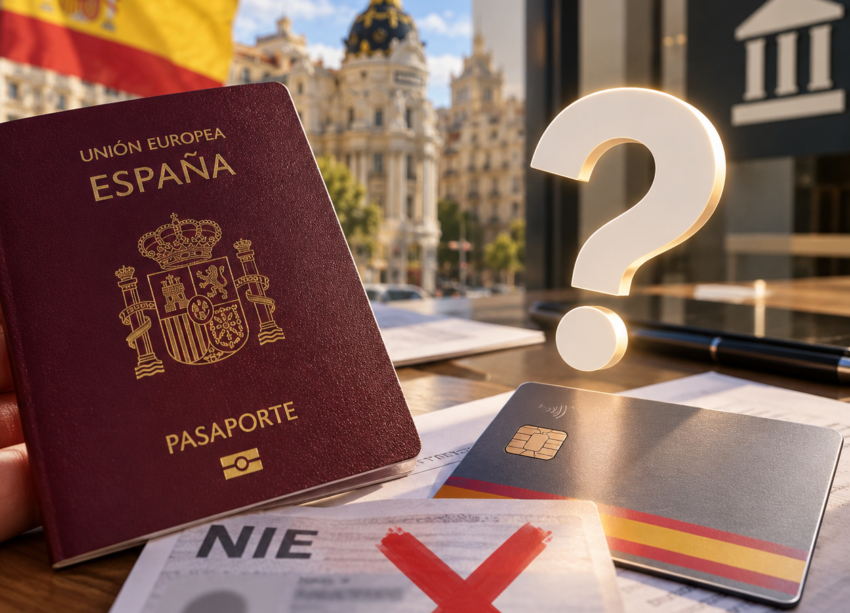
To open a bank account in Spain as a foreigner you will usually need a valid passport or ID, your NIE, proof of address and some proof of income or of why you need the account. Residents may also be asked for their residence card or registration certificate. Non-residents are often asked for proof of address abroad and an explanation of their link to Spain. Exact requirements differ by bank, branch and customer type, so ask in advance and bring originals and copies.
Disclosure: [Add affiliate disclosure here if this page contains affiliate links.] Requirements change and vary between banks and branches. Confirm the current list with the bank before you go. This guide is general information, not financial, tax or legal advice.
Table of contents
- The core documents every bank asks for
- Documents by situation
- How to get each document
- Document quality: dates, translations and legalisation
- Common document problems and fixes
- Frequently asked questions
- Printable checklist
1. The core documents every bank asks for
Almost every bank asks for the same four building blocks: who you are, your tax number, where you live and where your money comes from.
| Document | What it proves | Details to check |
|---|---|---|
| Passport (or national ID card for EU/EEA citizens) | Your identity | Must be valid, not expired and legible. Bring the original |
| NIE (Número de Identidad de Extranjero) | Your Spanish tax ID | Certificate or residence document showing the number; name must match your passport |
| Proof of address | Where you live | Spanish address (rental contract, utility bill, empadronamiento) or foreign address for non-residents (recent utility bill, bank statement, official letter) |
| Proof of income or activity | Source of funds | Payslip, employment contract, tax return, pension statement, business registration or student funding |
In addition, you will normally sign a tax residency self-certification at the bank, so you do not need to bring it. Just be ready to state your country of tax residence accurately.
[Internal link: Can You Open a Spanish Bank Account Without an NIE?]
2. Documents by situation
Banks adapt their requests to your profile. Use the table below as a starting point, then confirm with the bank.
| Your situation | Typical documents | Often also requested |
|---|---|---|
| EU/EEA citizen living in Spain | Passport or national ID, NIE, empadronamiento or rental contract, proof of income | EU registration certificate, employment contract |
| Non-EU resident in Spain | Passport, residence card (TIE) showing NIE, empadronamiento, proof of income | Work contract, visa or permit paperwork |
| Non-resident (owner or part-year visitor) | Passport, NIE, proof of address abroad, reason for the account | Property documents, proof of funds, reference from your home bank |
| Employee with a Spanish contract | Passport, NIE or TIE, address proof, employment contract and recent payslips | Employer details, social security number |
| Freelancer or self-employed | Passport, NIE, address proof, proof of registration as self-employed | Recent invoices, tax filings, bank statements |
| Student | Passport, NIE or student permit, proof of address, enrolment or admission letter | Proof of funds, scholarship letter, parents’ guarantee in some cases |
| Retiree | Passport, NIE, address proof, pension statements | Tax residency certificate from your home country |
| Property buyer | Passport, NIE, proof of address, proof of funds | Purchase contract, lawyer details, source-of-funds evidence |
| U.S. person | Standard documents plus extra tax forms | Additional reporting forms required by the bank |
Why the difference? Banks must understand who you are and why you need the account. The more complex your profile or the larger the amounts, the more evidence they may ask for.
3. How to get each document
Passport or national ID
Make sure it is valid for several months at least and that the photo and data page are clear. If it is close to expiry, renew it before applying, as some banks refuse documents that expire soon.
NIE
The NIE is issued by Spanish authorities. Non-residents typically apply through a Spanish consulate in their home country, at a police office handling foreigner matters in Spain, or through a representative. Residents receive it as part of their residence documentation. Waiting times vary, so start early.
[Internal link: NIE Number Explained: What It Is and How to Get One]
Certificado de empadronamiento (registration at your town hall)
If you live in Spain, register at your local town hall (padrón). You then request a certificate, often available online or in person, that confirms your address. Some banks require a recent certificate (for example, issued within the last few months).
Rental contract or utility bill
A signed rental agreement or a recent utility bill in your name (electricity, water, gas, internet) can serve as address proof. Not every bank accepts every type, so ask which is preferred.
Proof of address abroad (non-residents)
Use a recent utility bill, bank statement, tax letter or official document showing your name and foreign address. Many banks want it to be no more than three months old.
Proof of income or source of funds
- Employees: employment contract and the latest payslips.
- Self-employed: registration certificate, recent invoices and tax filings.
- Retirees: pension statement or letter from the pension provider.
- Students: admission letter and proof of funding (scholarship, family support, savings).
- Property buyers: purchase contract and evidence of where the funds come from, such as savings statements or a sale document.
Residence card or registration certificate
If you are a resident, your card or certificate shows your legal status and NIE. Ask the bank whether it needs the original, a copy or both.
4. Document quality: dates, translations and legalisation
Many delays come from paperwork that is correct in substance but not in form.
- Dates: proofs of address and income should usually be recent. When in doubt, use documents issued within the last three months.
- Matching names: the name must be identical across passport, NIE and address proof. If your name appears in a different order or with accents missing, ask the bank how to handle it.
- Language: documents in languages other than Spanish (and sometimes English) may need a sworn translation (traducción jurada) by a translator authorised in Spain. Some banks accept simple translations or English documents; others do not.
- Apostille or legalisation: for some official documents issued abroad, banks may ask for an apostille under the Hague Convention, or other legalisation. This is more common for civil or legal documents than for utility bills.
- Originals and copies: bring the originals and a photocopy of each document. Some branches scan them on the spot, others keep copies.
- Digital documents: some banks accept PDF statements or e-bills; others require printed, stamped versions. Ask beforehand.
5. Common document problems and fixes
| Problem | Why it happens | What to do |
|---|---|---|
| No NIE yet | Application pending or not started | Start the process; ask banks whether they can open a limited account or use a neobank temporarily |
| No Spanish address proof | You have just arrived or are staying temporarily | Ask whether a rental contract, a hotel or host letter, or proof of address abroad is acceptable |
| Address proof not accepted | Wrong type, too old or not in your name | Provide a utility bill or official letter dated within three months and in your name |
| Name mismatch | Different spellings across documents | Bring supporting documents and ask the bank to note the variation |
| No payslips | New job, freelancer or self-employed | Use the contract, invoices, tax registration or bank statements |
| Documents in a foreign language | Issued abroad | Ask whether a sworn translation is required; obtain it before the appointment |
| Bank asks for extra proof of funds | Large deposit or unusual profile | Prepare a clear explanation and supporting evidence such as a sale contract or savings statements |
| Different requirements at different branches | Local policy | Try another branch or bank, and note who gave you which answer |
6. Frequently asked questions
What documents do I need to open a bank account in Spain?
Usually your passport or ID, NIE, proof of address and proof of income or of the purpose of the account. Residents may also need a residence card or registration certificate.
Do I need a Spanish address?
Residents normally do. Non-residents can often use an address abroad, but the bank may ask for an explanation of their link to Spain.
Can I use a certificate of registration (empadronamiento) as proof of address?
Yes, many banks accept it, and some prefer it. Check whether it must be recent.
Do my documents need to be translated?
Only if the bank requires it. Documents in Spanish are simplest, and some banks accept English. When translation is needed, they may ask for a sworn translation.
How old can my proof of address be?
Often up to three months, but policies differ. Ask the bank.
Do I need a payslip?
Employees usually do. Other profiles can offer alternatives such as contracts, invoices, pension statements or tax filings.
Can I send documents online instead of going to a branch?
Some banks allow it, especially digital ones, while many traditional banks still require signing in person for non-residents.
What documents do students need?
Typically passport, NIE or student permit, proof of address, admission or enrolment letter and sometimes proof of funds.
Do U.S. citizens need extra documents?
Often yes. Because of U.S. tax reporting rules, banks may ask for additional forms and may be more cautious. Ask before you apply.
7. Printable checklist
Identity and tax
- Valid passport (or national ID for EU/EEA citizens)
- NIE certificate or residence document showing the NIE
- Residence card or EU registration certificate (if resident)
Address
- Certificado de empadronamiento or rental contract (if you live in Spain)
- Utility bill or official letter from abroad, dated within three months (if non-resident)
Income and purpose
- Payslips, contract, invoices, pension statement or admission letter
- Property documents or proof of funds (if buying or owning property)
- Short written explanation of why you need the account
Preparation
- Originals and photocopies
- Sworn translations or apostilles, if the bank requires them
- Appointment booked (cita previa)
- Questions ready about fees and conditions
Where to go next
- [How to Open a Bank Account in Spain as a Foreigner: Step-by-Step Guide]
- [Non-Resident Bank Account in Spain: Requirements, Banks and Fees]
- [NIE Number Explained: What It Is and How to Get One]
- [Do You Need an Address Certificate (Empadronamiento) to Open an Account?]