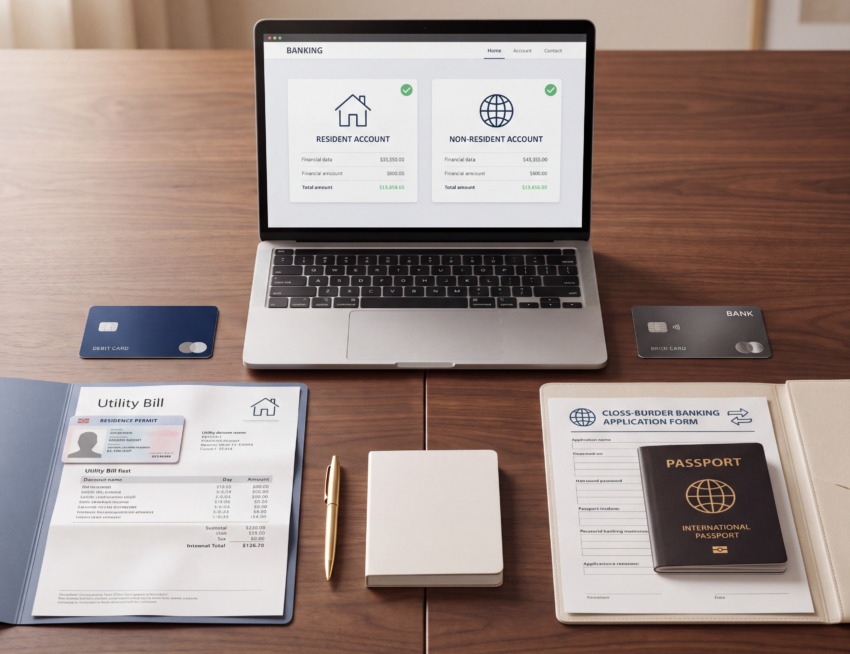
A resident account is for people who live in Spain and are registered as residents. A non-resident account is for people whose home and tax residence are elsewhere but who need a Spanish account, for example to pay for a property. The account works the same way day to day, but resident accounts usually have easier onboarding, lower fees, more products and more ways to waive charges, while non-resident accounts often involve more documents, higher fees or minimum balances, and a more limited range of products. Choose according to where you actually live and pay taxes, not where you would like to be classified.
Disclosure: [Add affiliate disclosure here if this page contains affiliate links.] Conditions vary by bank and change often. Confirm current terms with the bank. This guide is general information, not financial, tax or legal advice.
Table of contents
- What «resident» and «non-resident» mean for a bank
- Side-by-side comparison
- Differences explained
- Which one is right for you?
- Pros and cons
- Switching from non-resident to resident (and back)
- Common mistakes
- Frequently asked questions
- Checklist
1. What «resident» and «non-resident» mean for a bank
Banks classify customers based mainly on tax residence and the documents you can show.
- Resident customer: lives in Spain, usually holds a residence document or EU registration certificate, has a Spanish address and is expected to pay taxes in Spain.
- Non-resident customer: lives and pays taxes mainly in another country, but has a link to Spain such as a property, income, investments or periodic stays.
These terms are not the same as nationality. A Spanish citizen living abroad may be a non-resident customer, while a foreign citizen with a residence permit is a resident customer.
Important: Legal residence (immigration), tax residence and banking classification can differ. As a general idea, spending a large part of the year in Spain or having your main economic interests there can make you tax resident, but rules are detailed and depend on your situation. If you are unsure, ask a qualified tax adviser.
2. Side-by-side comparison
| Feature | Resident account | Non-resident account |
|---|---|---|
| Who it is for | People living in Spain and registered as residents | Property owners, part-year visitors, investors and people living abroad |
| Typical documents | Passport or ID, NIE, residence document, Spanish address proof, income proof | Passport, NIE, address abroad, reason for the account, proof of funds |
| Onboarding | Often easier, sometimes fully online | May require more checks, a branch visit or notarised documents |
| Monthly fees | Often lower and easier to waive (for example with salary domiciliation) | Often higher, or require a minimum balance or deposit |
| Product range | Full: cards, loans, mortgages, insurance, investments | Often narrower: some products limited or require extra conditions |
| Mortgage access | Usually easier | Possible, but conditions and requirements may be stricter |
| Salary and benefits | Designed for salary domiciliation and local benefits | Less suited if you earn income in Spain regularly |
| Direct debits | Standard | Standard, but may be restricted by some banks |
| Digital features (apps, Bizum) | Typically available | Often available, though some require a Spanish phone or additional verification |
| Tax reporting | Reported as resident in Spain | Reported according to your country of tax residence |
| Risk of account review | Lower if documents are current | Higher if documents expire or activity does not match the stated purpose |
| Best for | Living and working in Spain | Owning property or spending limited time in Spain |
3. Differences explained
3.1 Documentation
Resident accounts rely on documents that show you live in Spain: a residence card or EU registration certificate, a Spanish address (empadronamiento or rental contract) and often an employment contract. Non-resident accounts rely on proof of an address abroad and on a clear explanation of your link to Spain. Because the bank has fewer local records for non-residents, it may ask for more explanation and supporting evidence.
[Internal link: Documents Needed to Open a Bank Account in Spain]
3.2 Fees and conditions
Banks often reward residents who domicile a salary, hold products or maintain a balance, by waiving fees. Non-residents are less likely to qualify for these benefits, so they may pay maintenance and card fees, or be asked to keep a minimum balance. The details vary widely: always compare total yearly cost, not just the monthly headline.
3.3 Products and credit
Residents typically have access to the full catalogue: credit cards, overdrafts, personal loans, mortgages, insurance and investment products. Non-residents may find that some products are unavailable or require extra guarantees. If you plan to take a mortgage in Spain, ask the bank early about its non-resident conditions.
[Internal link: Mortgages for Foreigners in Spain: How They Work]
3.4 Onboarding and speed
Resident onboarding is often smoother, particularly with digital banks. Non-resident onboarding may need in-person signing, additional verification or documents certified by a consulate or notary. Plan extra time if you are a non-resident.
[Internal link: How to Open a Spanish Bank Account Online from Abroad]
3.5 Tax reporting
Banks report information on foreign account holders to tax authorities under international transparency rules. You will sign a tax residency self-certification when you open the account, and it must be accurate. Being a non-resident customer does not exempt you from tax obligations in Spain on Spanish-source income, and being a resident customer means your worldwide situation may be relevant in Spain. This area is complex, so consider professional advice.
3.6 Account reviews and closure risk
Banks periodically review customers. If your documents expire, your address changes or your activity does not match what you declared, the bank may ask for updates, restrict the account or close it. Keep your information current and tell the bank about changes in residence.
4. Which one is right for you?
Use this quick guide.
| Your situation | Likely account type | Notes |
|---|---|---|
| You live in Spain, have a residence document and a Spanish address | Resident | Best conditions; domicile salary if possible |
| You are an EU citizen who has registered as a resident in Spain | Resident | Bring your registration certificate |
| You own a holiday home and live abroad | Non-resident | Compare fees and minimum balances |
| You spend several months a year in Spain but are tax resident elsewhere | Non-resident (confirm with your adviser) | Be consistent with your tax declarations |
| You are moving to Spain next month | Non-resident now, then switch | Update the bank once you are registered |
| You are a digital nomad on a temporary stay | Depends on your status | A neobank may help alongside a Spanish account |
| You are a student with a long-stay permit | Often resident | Bring admission letter and permit |
| You are buying property and live abroad | Non-resident | Account usually needed for the purchase and taxes |
Do not choose a category just to get lower fees. Declaring the wrong status can cause problems with the bank and with tax authorities.
5. Pros and cons
Resident account
Pros
- Easier onboarding and a wider choice of banks
- More ways to waive fees (salary, products, balance)
- Full product range, including mortgages and credit
- Smoother use of local services such as Bizum
Cons
- Requires proof of residence in Spain
- Not available until you have registered and obtained your documents
- May involve obligations linked to your tax status in Spain
Non-resident account
Pros
- Available before you move or if you only own property
- Fewer requirements about Spanish documents such as empadronamiento
- Useful for managing property, taxes and local payments from abroad
Cons
- More paperwork and explanations
- Higher fees or minimum balances at many banks
- Limited products and possible in-person requirements
- Greater risk of review if circumstances change
6. Switching from non-resident to resident (and back)
When you move to Spain
- Register your stay and obtain your residence document or EU registration certificate.
- Register at the town hall (empadronamiento) and obtain the certificate.
- Tell your bank and provide the updated documents.
- Update your tax residency declaration at the bank.
- Ask for a switch to a resident account and review fees, cards and products.
- Consider domiciling your salary if you now work in Spain, as this often reduces fees.
When you leave Spain
- Notify the bank of your change in residence and tax status.
- Update your address and tax details.
- Review fees and conditions, since your account may be reclassified.
- Decide whether to keep or close the account, depending on your continuing needs.
Changing status without telling the bank can lead to restrictions or closure, so keep the bank informed.
7. Common mistakes
- Choosing the category by price instead of reality. Always declare your true status.
- Forgetting to update the bank after moving to or from Spain.
- Assuming all banks treat non-residents the same. Policies vary significantly.
- Ignoring the minimum balance or deposit required for non-residents.
- Comparing only the monthly fee. Check cards, transfers and conditions as well.
- Letting documents expire (passport, proof of address, residence card).
- Not asking about mortgage conditions before planning a purchase.
- Relying on a single bank. Apply to more than one if needed.
8. Frequently asked questions
What is the difference between a resident and non-resident bank account in Spain?
The account works the same way, but resident accounts are for people living in Spain and usually have easier onboarding and better conditions. Non-resident accounts are for people living abroad with a link to Spain and often involve more documents, higher fees and fewer products.
Is a non-resident account more expensive?
Often yes, but not always. Some banks charge higher maintenance fees or require a minimum balance, while others have similar conditions. Compare the total yearly cost.
Can a foreigner have a resident account?
Yes, if they live in Spain and can show the required documents, such as a residence card or EU registration certificate and a Spanish address.
Can I keep my non-resident account after I move to Spain?
You should tell the bank. Many banks will switch you to a resident account, and your fees and conditions may change.
Do I need an NIE for both types?
Most banks require an NIE for both, although some may open limited non-resident accounts with a passport and request the NIE later.
Which account is better for buying property?
Usually a non-resident account if you live abroad, or a resident account if you already live in Spain. Ask your lawyer and the bank about requirements.
Can a non-resident get a mortgage in Spain?
Often yes, but conditions can be stricter, such as larger deposits. Ask the specific bank.
Does the type of account change my taxes?
No. The account type is a banking classification. Your tax obligations depend on your tax residence and income, so ask a tax adviser if unsure.
9. Checklist
- Confirm your real tax residence and legal status
- Choose the account type that matches that status
- Prepare documents for that type
- Compare fees, minimum balances and products at two or three banks
- Ask about mortgage and credit conditions if relevant
- Plan to update the bank if your residence changes
- Keep documents current to avoid account reviews
Where to go next
- [How to Open a Bank Account in Spain as a Foreigner: Step-by-Step Guide]
- [Non-Resident Bank Account in Spain: Requirements, Banks and Fees]
- [Best Bank for Non-Residents in Spain]
- [Mortgages for Foreigners in Spain: How They Work]