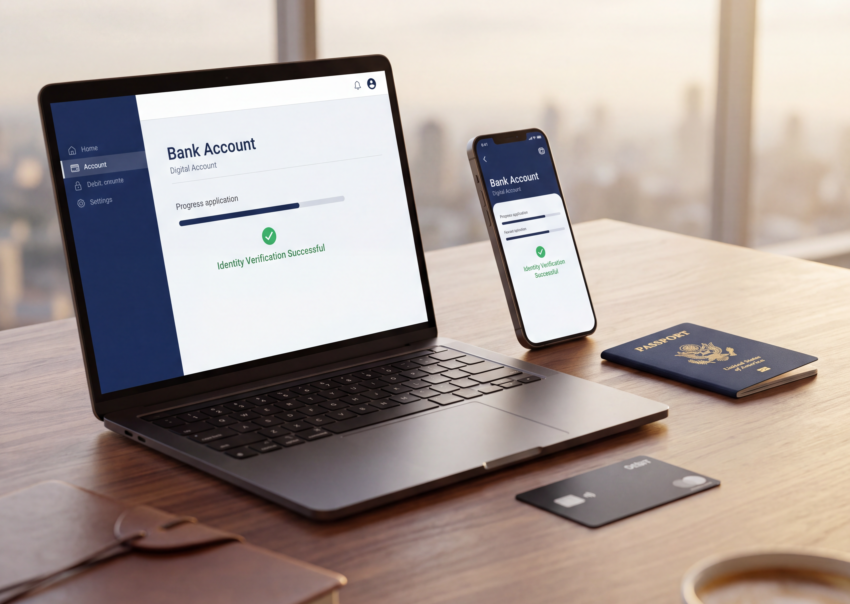
It is possible, but how easy it is depends on the bank and on your situation. Some Spanish digital banks let you apply online with a passport or ID, a selfie or video check and a few documents. Many traditional banks still need you in person, or documents certified by a notary or consulate. If you need an account before you arrive, there are three realistic routes: a Spanish digital bank, a traditional bank with remote onboarding, or a neobank as a temporary solution. The main obstacles are usually the NIE, a Spanish phone number and your tax residence.
Disclosure: [Add affiliate disclosure here if this page contains affiliate links.] Bank policies change often and differ between providers. Confirm current conditions with the bank before you apply. This guide is general information, not financial, tax or legal advice.
Table of contents
- Can you really open an account from abroad?
- Three routes compared
- What you usually need
- Step-by-step: the online application
- Common obstacles and how to solve them
- Opening with a representative or power of attorney
- Staying safe: scams and fake bank sites
- What to do after the account is open
- Frequently asked questions
- Checklist
1. Can you really open an account from abroad?
Yes, in some cases. Spanish rules require banks to identify customers properly, but they allow remote identification when done securely, for example by video call or digital verification. That is why some banks can onboard you without a branch visit.
In practice, three things decide whether it works for you:
- The bank’s policy. Some accept only residents in Spain, others accept non-residents, and others accept customers from certain countries only.
- Your documents, especially whether you already have an NIE.
- Your profile: nationality, tax residence, expected activity and amounts.
Because policies vary, never assume that a method that worked for someone else will work for you. Check each bank’s current conditions.
2. Three routes compared
| Route | How it works | Pros | Cons |
|---|---|---|---|
| A. Spanish digital bank, fully online | Apply in an app or website, upload documents, verify identity by selfie or video call | Fast, low fees, no travel | Often requires NIE, may require Spanish phone number or address, not all accept non-residents |
| B. Traditional bank with remote steps | Start online or by email, then sign through a notary, consulate or representative | Full range of products, mortgages, local service | Slower, more paperwork, may still need a visit |
| C. Neobank or money app | Open in minutes with passport and selfie | Very easy, multi-currency, good for transfers | IBAN may not be Spanish, some Spanish payers may not accept it, fewer local services |
Many people combine C (immediately) with A or B (when they have the NIE or arrive in Spain).
[Internal link: Best Online Banks in Spain for Foreigners] [Internal link: Is Revolut Enough for Living in Spain?]
3. What you usually need
The exact list depends on the route, but these are common.
- Passport or national ID, valid and in good condition. For video verification, have the original document available.
- NIE (Número de Identidad de Extranjero). Many Spanish banks require it even for online opening. Some neobanks do not.
- Proof of address. For non-residents, a recent utility bill or bank statement from abroad; for residents, a Spanish address document.
- Proof of income or source of funds, for example payslips, a pension statement or a tax return.
- A working email address and mobile phone. Some banks send verification codes by SMS to a Spanish mobile number; others accept foreign numbers or app-based verification. Ask before you start.
- A smartphone or computer with a camera for selfie and video checks, with a stable connection and good lighting.
- Tax residency details, including your tax identification number in your country of residence. You will be asked to self-certify.
[Internal link: Documents Needed to Open a Bank Account in Spain]
4. Step-by-step: the online application
Step 1: Define what you need
Decide whether you need a full Spanish account (for rent, salary, bills) or just a way to move and hold euros while you prepare your move. This determines which route to choose.
Step 2: Check eligibility before you start
Before creating an application, check on each bank’s website or by email:
- Do they accept non-residents, and customers living in your country?
- Is an NIE required at the time of opening?
- Do they require a Spanish phone number or address?
- Do they accept your nationality, including special rules for U.S. persons?
Save the answers. A written reply protects you if conditions are applied differently later.
Step 3: Apply for the NIE if you do not have it
If the bank requires an NIE, start that process in parallel. Non-residents commonly apply through a Spanish consulate in their country, at a police office in Spain or through a representative.
[Internal link: NIE Number Explained: What It Is and How to Get One]
Step 4: Prepare your documents in digital form
Scan or photograph your documents in good quality. Make sure all four corners are visible, there is no glare and the text is readable. Name the files clearly.
Step 5: Start the application
Complete the form with details that match your documents exactly. Mistakes in names, dates or addresses are a common reason for rejection.
Step 6: Complete identity verification
Expect one or more of the following:
- Selfie check matched with your document.
- Video call with a bank agent, who asks you to show your ID and sometimes to answer questions.
- Document verification by upload.
Do this in a quiet place, with good lighting and your original documents at hand.
Step 7: Answer compliance questions honestly
You will probably be asked about the purpose of the account, your source of funds, your expected activity and your tax residence. Give clear, consistent answers, and keep supporting documents ready in case of a follow-up request.
Step 8: Sign and fund the account
Most online banks use electronic signature. Read the contract and the fee schedule before accepting. Some banks require an initial transfer from an account in your name to confirm ownership. Use a transfer from your own account to avoid problems.
Step 9: Activate card and online banking
You will receive your IBAN quickly in many cases. The card and credentials may arrive by post to the address you provided, or be issued digitally. If the card is posted to a Spanish address you cannot access yet, ask about alternatives, such as a virtual card or a delivery address abroad.
5. Common obstacles and how to solve them
| Obstacle | Why it happens | What to try |
|---|---|---|
| «NIE required» | Tax identification and compliance rules | Apply for the NIE first; ask whether a limited account is possible; use a neobank in the meantime |
| Spanish phone number required | Verification by SMS | Ask whether a foreign number or app verification is accepted; get a Spanish SIM or eSIM if you will need it anyway |
| Spanish address required | Bank only serves residents | Look for banks accepting non-residents with a foreign address |
| Video check fails | Poor lighting, glare or document damage | Retry in daylight; use a clean, undamaged document; ask support for alternatives |
| Application rejected without clear reason | Compliance or profile decision | Ask politely for the reason; try another bank; keep your documents consistent |
| Card cannot be delivered abroad | Posting only to Spanish addresses | Ask for a virtual card or a trusted contact’s address in Spain |
| U.S. person turned down | Additional tax reporting burden | Ask banks upfront about U.S. clients; compare alternatives |
| Name mismatch | Different spelling across documents | Use the exact name on your passport and explain variants with supporting papers |
6. Opening with a representative or power of attorney
If the bank requires an in-person visit and you cannot travel, you may be able to open the account through a trusted person.
- A power of attorney (poder) is a legal document that authorises someone to act for you. It is usually signed before a notary or at a Spanish consulate, and may require an apostille or translation if signed abroad.
- The representative must meet the bank’s requirements and bring your documents.
- Be careful with scope. Limit the authority to the specific task (opening an account), do not give broad powers, and consider asking a lawyer to draft it.
- Avoid giving your online banking credentials to anyone, including representatives.
This route adds cost and time, so use it only if the online route is not available.
[Internal link: Non-Resident Bank Account in Spain: Requirements, Banks and Fees]
7. Staying safe: scams and fake bank sites
Online account opening attracts scammers. Protect yourself:
- Use the official website or app of the bank. Type the address yourself or download the app from the official store; do not follow links in unsolicited messages.
- Never pay anyone to «guarantee» an account or to open it «without documents».
- Do not share PINs, passwords, card numbers or one-time codes. Real bank staff do not ask for them.
- Check the licence. Make sure the bank is authorised and registered; the Bank of Spain publishes a register of supervised entities, and the European Central Bank and other authorities publish registers for banks licensed in other EU countries.
- Be cautious with documents. Send identity documents only through the bank’s secure upload, not by regular email or chat.
- Beware of urgency. Messages pressing you to act immediately are a typical sign of fraud.
[Internal link: Common Bank Scams Targeting Expats in Spain]
8. What to do after the account is open
- Check your IBAN and personal details in the contract and the app.
- Enable two-factor authentication and set a strong, unique password.
- Make a small test transfer before sending larger amounts.
- Set up direct debits for rent and utilities if you need them.
- Update your employer, landlord or pension provider with your new IBAN.
- Keep copies of the contract, fee schedule and verification documents.
- If your residence changes, tell the bank so your tax and address details stay current.
9. Frequently asked questions
Can I open a Spanish bank account online without going to Spain?
Some banks allow it, especially digital ones. Many traditional banks still require an in-person visit or certified documents.
Do I need an NIE to open an account online?
Often yes. Some banks may open a limited account first and require the NIE later, while neobanks may not require it at all.
Can I open an account online as a non-resident?
It depends on the bank. Some accept non-residents with a foreign address, while others serve only residents.
How long does online account opening take?
From a few minutes (neobanks) to a few days or weeks (Spanish banks, depending on verification, document review and the NIE).
Do I need a Spanish phone number?
Some banks require it for SMS verification. Check beforehand and consider a Spanish SIM or eSIM if you are moving.
Can I get a Spanish IBAN from a neobank?
Some neobanks issue IBANs from other countries rather than Spain. Check which IBAN you get and whether your landlord, employer or utility accepts it.
Is it safe to open a bank account online?
Yes, if you use the official website or app of a licensed bank and follow basic security rules. Avoid third parties who promise guaranteed approval for a fee.
What if the bank asks me to visit a branch?
Ask whether a representative, consulate or notary route is available, or consider another bank or a neobank as a temporary solution.
10. Checklist
Before applying
- Decide whether you need a Spanish account or a temporary solution
- Check each bank’s rules for non-residents and your nationality
- Start the NIE process if needed
- Scan passport, address proof and income documents clearly
- Confirm whether a Spanish phone number is required
During the application
- Use the official website or app
- Enter names and dates exactly as on your documents
- Do the video or selfie check in good light with the original document
- Answer compliance questions consistently
After opening
- Enable two-factor authentication
- Make a small test transfer
- Share your IBAN with employer, landlord or utilities
- Save copies of the contract and fee schedule
Where to go next
- [How to Open a Bank Account in Spain as a Foreigner: Step-by-Step Guide]
- [Can You Open a Spanish Bank Account Without an NIE?]
- [Best Online Banks in Spain for Foreigners]
- [Common Bank Scams Targeting Expats in Spain]