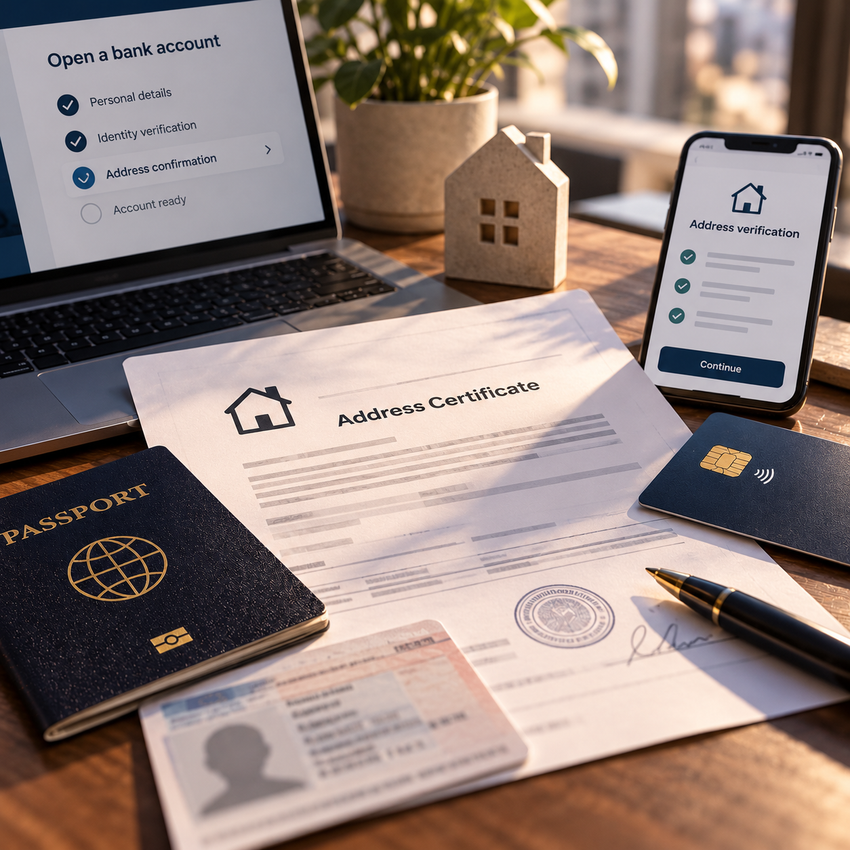
Not always, but it helps a lot. If you live in Spain, many banks accept or prefer a certificado de empadronamiento (proof that you are registered at your town hall) as proof of address, although some also accept a rental contract or a recent utility bill in your name. If you are a non-resident, banks usually ask for proof of an address abroad instead. Requirements vary by bank and branch, so ask which documents they accept before you go.
Disclosure: [Add affiliate disclosure here if this page contains affiliate links.] Procedures for registering at the town hall differ by municipality and change over time. Confirm the current process with your local town hall and the bank. This guide is general information, not financial, tax or legal advice.
Table of contents
- What is empadronamiento?
- Do banks require it?
- Alternatives if you do not have it yet
- Non-residents: what to use instead
- Certificate or volante: which one to ask for
- How to register and get the certificate
- Common problems and fixes
- Other reasons to register
- Frequently asked questions
- Checklist
1. What is empadronamiento?
Empadronamiento is the registration of your address in the municipal register (padrón municipal de habitantes) of the town hall where you live. Anyone who lives in a Spanish municipality is expected to be registered there, regardless of nationality or legal status, as a general rule.
From the register you can request a document, usually called a certificado de empadronamiento (or a similar simpler document called a volante), which confirms that you live at a given address. Public bodies and many private companies use it as proof of address.
It is not the same as a residence permit. Registering in the padrón does not by itself grant legal residence, and having a residence permit does not automatically register you in the padrón. They are separate processes.
2. Do banks require it?
There is no single rule that applies to all banks. In practice:
- Many banks accept it as proof of address for residents, and some prefer it because it is an official document.
- Some banks ask for it specifically when you say you live in Spain and have no other proof.
- Other banks accept alternatives such as a signed rental contract, a utility bill or a document from your employer.
- Digital banks and neobanks may use address checks that rely on other documents or on a postal verification.
- Non-resident accounts generally do not require it, because you are not registered in Spain.
Because policies differ, the safest approach is to ask the bank: «Which documents do you accept as proof of address for a new resident?» and, if possible, get the answer in writing.
[Internal link: Documents Needed to Open a Bank Account in Spain]
3. Alternatives if you do not have it yet
If you have just arrived and have not registered yet, ask whether one of these is accepted:
| Alternative | Notes |
|---|---|
| Signed rental contract | Often accepted, especially if it names you and shows the address |
| Property deeds or purchase contract | For owners, together with ID |
| Recent utility bill (electricity, water, gas, internet) | Must be in your name and recent, often within three months |
| Letter from your employer | Some banks accept it when you start a new job |
| Residence document that shows an address | Depends on the document; some do not show the address |
| Host or landlord declaration | Accepted by some banks, with a copy of the host’s ID |
| Hotel or temporary lodging confirmation | Accepted rarely and usually only for a limited or non-resident account |
If none of these works, ask the bank about opening a limited account first and bringing the empadronamiento later, or consider a neobank as a temporary solution.
[Internal link: Can You Open a Spanish Bank Account Without an NIE?]
4. Non-residents: what to use instead
If you do not live in Spain, you will not be registered in a Spanish municipality. Banks then usually ask for proof of your address abroad, such as:
- a recent utility bill or telecom bill;
- a bank statement from your home country;
- a tax letter or official document showing your address;
- a rental contract or property document abroad.
Most banks want these documents to be recent, often within the last three months, and in your name.
If you own property in Spain but live abroad, your Spanish property documents are useful to explain why you need the account, but they usually do not replace proof of your address abroad.
[Internal link: Non-Resident Bank Account in Spain: Requirements, Banks and Fees]
5. Certificate or volante: which one to ask for
Town halls may offer different versions of the document. Names and formats vary by municipality.
| Document | What it is | When it is useful |
|---|---|---|
| Certificado de empadronamiento | Official certificate that you are registered at an address | Banks and public offices that ask for an official proof |
| Volante de empadronamiento | Simpler proof of registration | Some banks and companies accept it; others do not |
| Certificado histórico | Shows previous addresses and dates | Sometimes requested for specific procedures; not needed for most bank accounts |
| Certificado colectivo | Lists all people registered at the address | Rarely needed for banks |
Ask the bank which one they need and whether it must be recent (often issued within the last three months). If you are not sure, request the certificate, since it is usually more widely accepted.
6. How to register and get the certificate
The process differs by municipality, but it generally follows these steps.
Step 1: Check the local procedure
Visit your town hall’s website or call its citizen service. Many municipalities require an appointment (cita previa) and some allow online registration for people with a digital certificate.
Step 2: Gather documents
Common requirements include:
- Passport or ID and, if you have it, your NIE.
- Proof that you live at the address: a rental contract, property deed or similar document.
- A completed registration form (hoja padronal), often provided by the town hall.
- If you live in someone else’s home: their authorisation and a copy of their ID, as the town hall may require it.
- For minors or other household members: additional documents, such as a family book or birth certificates.
Step 3: Submit the application
Present the documents in person or through the town hall’s electronic office. Some municipalities complete the registration the same day; others take longer or ask for later confirmation.
Step 4: Request the certificate
Once registered, ask for the certificate or volante. In many places you can obtain it immediately at the office or download it online. Some town halls charge a small fee, and others do not.
Step 5: Give it to the bank
Bring the original and a copy to your bank appointment, and check whether the bank needs it to be recent.
Tip: when you move, update your registration. The padrón should match your current address, and some banks or public bodies check it.
7. Common problems and fixes
| Problem | Why it happens | What to try |
|---|---|---|
| Landlord does not want to register you | Concerns about taxes or the rental arrangement | Ask the town hall what documents they accept; the registration is generally an obligation for people living at the address, so ask for the official procedure |
| No rental contract | Informal or short-term arrangement | Ask the town hall about alternatives, such as a declaration from the owner with ID |
| Cannot get an appointment | Backlog | Check online options, other town hall offices or a gestoría for help |
| Bank rejects the document | Too old, wrong version or not matched to your name | Request a new certificate and check the name and address match your other documents |
| Address differs from other documents | Moved recently or spelling differences | Update your records and bring supporting documents |
| You are staying only a few weeks | No stable address yet | Ask about limited or non-resident accounts, or use a neobank temporarily |
| Document in another language | Issued abroad | Ask the bank whether a translation is needed |
If you face difficulties registering, ask the town hall for the official procedure in writing or seek advice from a lawyer, a gestoría or a local organisation that supports newcomers.
8. Other reasons to register
Beyond opening a bank account, being registered at your address is often useful or required for:
- Public healthcare access (in many regions, the registration is part of the process).
- Enrolling children in school.
- Applying for residence permits and other administrative procedures.
- Signing up for utilities, internet and some services.
- Proving the time you have lived in Spain for certain procedures.
- Local services and benefits managed by the municipality.
Rules differ by region and situation, so check which requirements apply to you.
9. Frequently asked questions
Do I need empadronamiento to open a bank account in Spain?
Not always, but many banks accept or prefer it as proof of address for residents. Some accept a rental contract or utility bill instead. Non-residents usually use proof of an address abroad.
What is a certificado de empadronamiento?
An official document from your town hall that confirms you are registered at your address.
Is empadronamiento the same as a residence permit?
No. The padrón is a municipal register of where you live. A residence permit or registration certificate is a separate immigration status.
How recent must the certificate be?
Often within the last three months, but it depends on the bank. Ask them.
Can I get it without a rental contract?
Sometimes, with alternative documents such as an owner’s declaration and ID. The requirements depend on the municipality.
Can I open an account before I register?
Possibly, with a rental contract, a utility bill or a limited account, but policies differ. Neobanks can be a temporary solution.
How long does registration take?
From the same day to a few weeks, depending on the town hall and appointment availability.
Is it free?
Some town halls offer it free and others charge a small fee for the certificate. Check your municipality.
Do non-residents need it?
No, since non-residents do not live in Spain. They typically provide proof of an address abroad.
What if I change address?
Update your registration with the town hall and tell your bank, so your records stay consistent.
10. Checklist
- Ask the bank which proof of address it accepts
- Check whether it must be recent
- Book your cita previa at the town hall if required
- Gather passport or ID, NIE, rental contract or property document
- Get the owner’s authorisation if you live in someone else’s home
- Request the certificado (not just the volante) if unsure
- Check that names and address match your other documents
- Keep an original and a copy for the bank
- Update your registration if you move
Where to go next
- [How to Open a Bank Account in Spain as a Foreigner: Step-by-Step Guide]
- [Documents Needed to Open a Bank Account in Spain]
- [Checklist: First 30 Days in Spain (NIE, Padrón, Bank, Health)]
- [NIE Number Explained: What It Is and How to Get One]